Turn customer feedback into product decisions
Bagel AI is the product brain that reads your sales calls, support tickets, chats and threads, then ties every request to its accounts. Your team and your coding agents get a ranked, scoped decision, and after launch Bagel AI checks whether it worked.









Customer feedback piles up faster than anyone can read it

Requests arrive in a dozen places
The same ask can come up in one week on a sales call, in a support ticket, in a chat and in a thread. Each sits in a different tool, so it rarely gets counted as one request.

Tagging falls behind
Manual tags hold up while feedback arrives in dozens a week. At thousands a week the taxonomy drifts, and the pile of untagged feedback keeps growing.
Mention counts can’t tell urgent from loud
A count shows how often a request came up, and the revenue behind it lives in the CRM. Priorities get set by volume and by whoever argues hardest in the planning meeting.
Launch results rarely reach the next roadmap
Once a feature ships, there’s seldom a clean way to see whether it changed churn or revenue for the accounts that asked. So the next planning cycle starts from opinions.
See every mention land on one ranked request
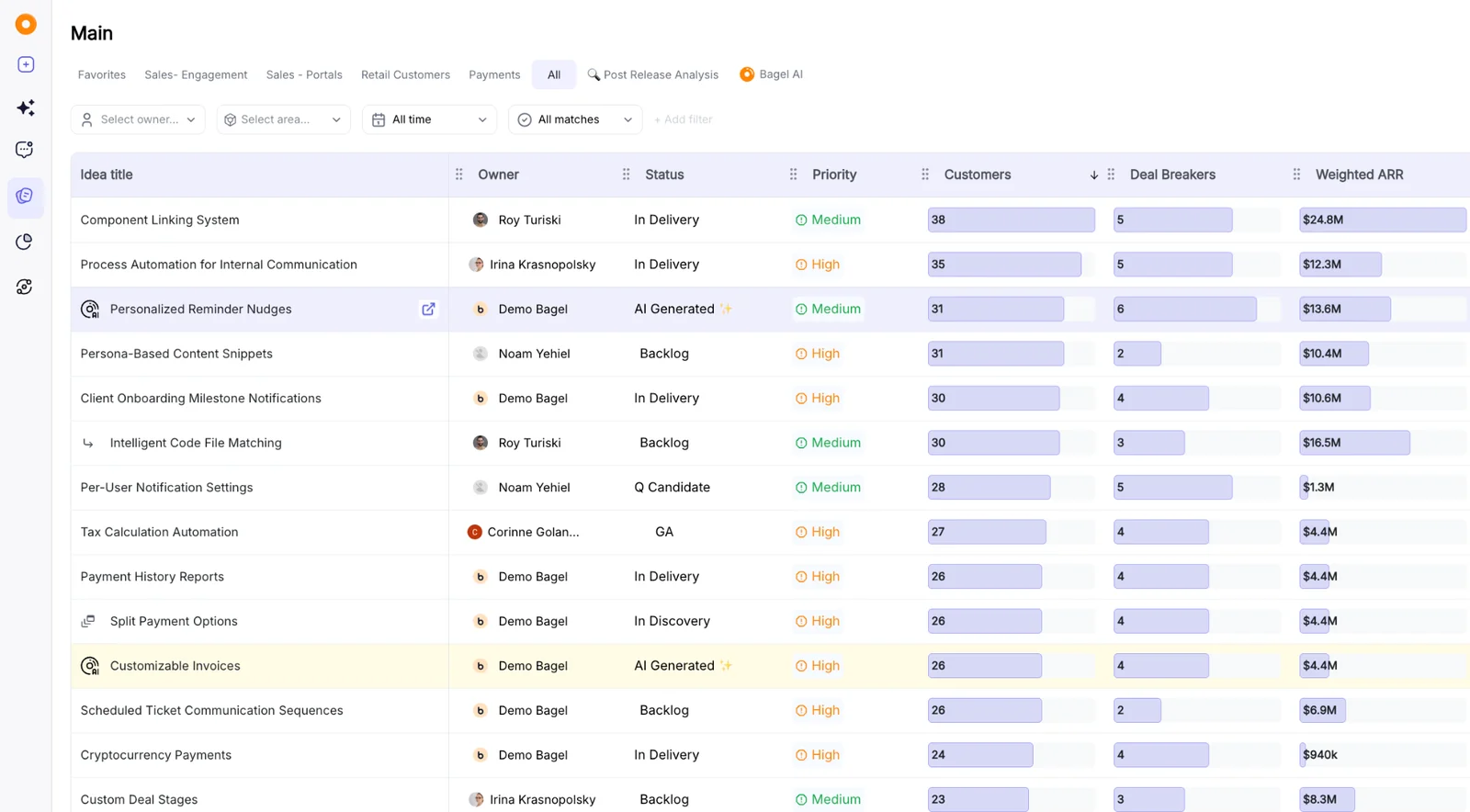
A sales call, a support ticket and a survey answer ask for the same thing. In Bagel AI they become one request, tied to the accounts behind it.
What is customer feedback software?
Customer feedback software collects what customers say about a product and helps a team act on it. Survey tools and feedback boards gather new feedback. Analytics tools find themes in feedback that already exists, in sales calls, support tickets, chats and threads. A product brain like Bagel AI ranks each request by revenue or another KPI and gives the team a decision.
| Kind of tool | What it gives you, and where it stops |  What Bagel AI adds |
|---|---|---|
 Survey and NPS tools | Scores and answers Covers only what you thought to ask, from the customers who answered | Every source Reads survey answers next to calls, tickets, chats and threads, where customers raise things no survey asked about |
 Feedback boards and idea portals | Votes on requests By default each vote counts the same, so a free user weighs as much as your largest account | Revenue-weighted Ranks each request by the revenue or KPI behind it |
 Feedback analytics and voice of customer platforms | Themes and sentiment A theme still needs someone to make it a decision and write the ticket | Scoped decisions Scoped decisions that go to Jira or Linear as tickets |
 Roadmap tools with a feedback inbox | Feedback linked to features Someone tags and links each note by hand | Tagged by a model Tags and merges feedback with a model trained on your data |
For specific tools, the compare hub puts Bagel AI side by side with nine of them.
What Bagel AI does with every piece of feedback
This example follows a request for reminder nudges in a demo workspace, from the first sales call to the review after launch.
01 · Signal
Read every source
Sales calls, support tickets, chats, threads and survey answers come in next to usage and revenue data. A model trained on your company reads all of it.
100+ integrations02 · Evidence
Merge the same ask
When a customer asks for the same thing on a call and in a ticket, Bagel AI merges the two under one account.
90% fewer duplicates03 · Decision
Rank by your KPI
Requests are ranked by ARR, churn risk, deal blockers, NPS or a formula you define. Each comes back as a scoped decision with the quotes attached.
95%+ accuracy04 · Hand-off
Send the spec
Decisions go to Jira or Linear as scoped tickets. Coding agents pull the same decision over Bagel MCP in about 12X fewer tokens than the raw data.
12X fewer tokens05 · Outcome
Check what shipped
After launch, Bagel AI tracks whether the feature moved that KPI for the accounts that asked, and the result feeds the next ranking.
The numbers behind the product brain
Click through the real product
Two interactive tours of a demo workspace. In AI Product Opportunities, every request comes ranked by the KPIs you track. In Discovery OS, your team and your agents ask Bagel AI anything and get the answer in minutes, evidence attached.
Let Bagel AI do the tagging and triage
A model trained on your company’s data tags and merges every call, ticket, chat and thread as it arrives. Your team starts from requests that are already grouped and ranked.

Automatic tagging and theme detection
Every call, ticket, chat and thread gets tagged as it arrives and grouped into themes. The model trained on your data builds the taxonomy, so there are no rules to write and no labels to maintain.

One intake queue for every team
Requests from sales, CS, support and product land in one queue, already merged and tagged. The triage calculator shows what manual triage costs your team today.
One taxonomy across the company
Every team reads the same themes, so a request means the same thing in a sales review and in sprint planning. When customers start using new words, the themes update without a rebuild.
Voice of customer reports on demand
Ask Bagel AI for the top requests and the revenue behind them before a board meeting. Alerts flag a deal blocker or a churn signal as it comes in.
See what triage costs you today
Pick who sorts your feedback now and how much of it comes in each week.
83
hours of manual triageHours are items times minutes, divided by 60. A year counts 48 working weeks.
630K
tokens burned reading each item onceAcross a 13-week quarter it adds up to about 8.2M tokens. That’s 8.2 times a 1M-token window, so no single chat can read it all.
Run the full token checkCalls run 30 minutes at 150 words a minute, tickets 150 words, and a token is about 0.75 words. A mix is 400 calls to 5,000 tickets. Bagel AI’s figure uses its 13.6x benchmark ratio.
What to look for in customer feedback software
Six questions to ask any vendor, with Bagel AI’s answer to each.
| Question to ask | Why it matters | Bagel AI |
|---|---|---|
| Does it read the feedback you already have? | Sales calls, support tickets, chats and threads hold more than any survey | 100+ integrations Connects to 100+ tools, with native Jira, Linear and GitHub support |
| Does it merge the same request across sources? | Duplicates inflate some requests and bury others | 90% fewer duplicates The same ask from a call and a ticket lands as one request, tied to one account |
 Can it rank by revenue or another KPI? | A mention count favors whoever posts most | Any KPI Ranks by ARR, NPS, churn risk, deal blockers or your own formula |
| Does it send engineers a spec? | Someone still has to write the ticket before engineers can build | Jira, Linear, MCP Scoped tickets in Jira or Linear, and decisions served to coding agents over Bagel MCP |
| Does it check what shipped? | Without a check, the last launch can’t inform the next ranking | KPI, by account Tracks the KPI after launch for the accounts that asked |
 Is it safe for enterprise data? | Feedback carries customer names and deal details | SOC 2 Type II SOC 2 Type II, SSO, a dedicated model per customer and minimal PII by design |
Product teams at Gong and Tipalti on Bagel AI
“Every SaaS company hits a point where feedback piles up but decisions stall. Bagel AI turns that mess into clear, revenue-focused priorities.”

“Completes the long-time missing part between revenue, product and the customer. It is a product market fit pulse on autopilot”

Enterprise-grade Product Brain
Bagel AI runs a dedicated model for each customer, and your data never trains anyone else’s model. It’s SOC 2 Type II certified and GDPR ready, with SSO, role-based access, full audit logs and PII reduction by design. The security page has the details.


AI Transparency
Complete visibility into how your data is handled and applied across Bagel AI Platform.

Enterprise-grade security
SOC2 Type II compliance for always-on protection you can trust.

Minimal PII by Design
Reduces exposure to personally identifiable information while keeping context intact privacy-first without sacrificing insight.
Questions about customer feedback software
It depends on the job you need done. A survey tool fits when you need scores, and a feedback board fits when you want customers to vote in public. To decide what to build from the calls, tickets, chats and threads you already have, product leaders use a product brain like Bagel AI. It ranks every request by revenue or your KPI and checks the result after launch.
Several feedback analytics tools do, and Bagel AI is one of them. Bagel AI tags each call, ticket, chat and thread with a model trained on your company’s data, so there’s no taxonomy to build. It also ties every theme to the accounts and revenue behind it.
Start with one intake queue for every team, then automate the sorting. Manual triage holds up at dozens of items a week and breaks at thousands. Bagel AI merges duplicates and tags each item as it arrives, then ranks the queue by your KPI. The triage calculator shows what manual triage costs you today.
Let the taxonomy come from what customers say, and keep it in one place. Bagel AI builds it with a model trained on your data and updates it as customers start using new words. Sales, CS, support and product all read the same themes.
No. Bagel AI doesn’t send surveys. It reads the survey answers you already collect next to sales calls, support tickets, chats and threads. Then it ranks what customers ask for across all of them.
No. Bagel AI connects to the tools you already run and reads what they collect. Some product leaders later move off Productboard and run on Bagel AI alone, and the Productboard comparison covers both setups.
Plans start at $24K a year on Pro, with unlimited seats and no per-seat fees. The price depends on how much feedback you bring in, and connecting more tools doesn’t change it. You can start with a paid 30-day pilot on your own data, and its cost comes off your first year if you continue.
Yes. Each customer gets a dedicated model, and your data never trains another customer’s model. Bagel AI is SOC 2 Type II certified, and the report sits in the Trust Center. The security page covers SSO, role-based access, audit logs and PII handling.
Still have questions? Ask your AI about Bagel AI
See what your customers are asking you to build
In 30 minutes we’ll show you how Bagel AI ranks feedback like yours and builds the case behind each decision. The 30-day pilot runs it on your own data.